

Cursor Obsidian sync —
your vault, fed into Cursor
EVC Local Sync keeps an Obsidian vault synced into a Cursor project's /docs folder and auto-places a .cursor/rules/docs-sync.mdc file, so Cursor's Agent mode always reads your current specs — not a stale copy.
Cursor Obsidian sync is the setup EVC Local Sync creates between an Obsidian vault and a codebase opened in Cursor: a vault folder holding your specs, PRDs, or architecture notes is bidirectionally synced with the project's /docs folder, and a Cursor rules file is auto-placed so the editor's AI already knows how to use it. No manual copy-paste, no stale context, no extra service to run.
Why Cursor's Agent mode drifts from your specs
Your source of truth lives in Obsidian. Cursor only ever sees what's on disk.
Problem
No .cursor/rules pointing at your specs
Solution
Local Sync auto-places docs-sync.mdc during setup — Cursor picks it up on next open.
Problem
/docs goes stale the moment you edit the vault
Solution
Auto-sync on change keeps /docs current every time you save in Obsidian — Cursor's next read gets the real thing.
Problem
Agent edits overwrite your notes
Solution
Conflict resolution + backup-before-overwrite means a Cursor Agent write never silently clobbers your vault.
What Local Sync places in .cursor/rules/
Scoped to your /docs glob, applied automatically by Cursor — chat, inline edit, and Agent mode alike.
---
description: Rules for working with /docs synced via EVC Local Sync
globs: docs/**/*.md
---

# Documentation Sync Rules

The `/docs` folder is bidirectionally synced with an Obsidian vault via Local Sync.

## Rules:
- Read `/docs` files before making changes to understand current state
- Update `/docs` when modifying project specs or architecture
- Never delete `/docs` files without explicit user confirmation
- Reference `/docs/PRD.md` as the source of truth for requirementsMap your folders
Point a vault folder at your Cursor project's /docs.
Rules file lands automatically
Local Sync drops docs-sync.mdc into .cursor/rules/.
Open Cursor, agent reads current docs
Chat, inline edit, and Agent mode all see the synced, up-to-date version.
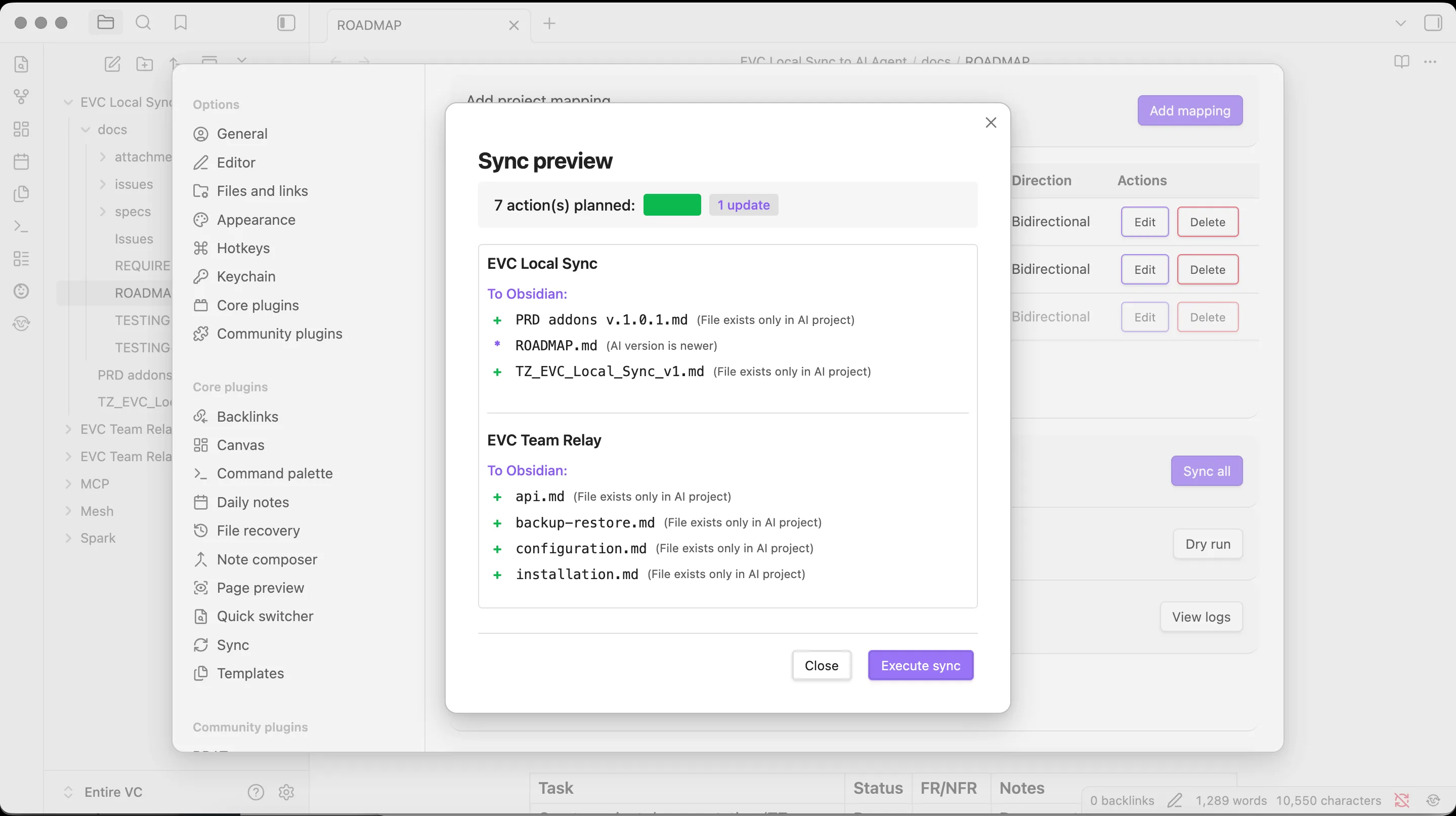
See the mapping before it syncs
Dry-run preview shows exactly what will change in /docs before Local Sync touches a single file.
Feeding Cursor context — the options
| Local Sync | Manual copy-paste | Symlink /docs | |
|---|---|---|---|
Auto-configures .cursor/rules | ✓ | ✗ | ✗ |
| Bidirectional (Cursor edits flow back to vault) | ✓ | ✗ | OS-dependent |
| Conflict resolution | 4 strategies | — | — |
| Works across OSes without admin rights | ✓ | ✓ | ✗ |
| Cost | Free | Free (your time) | Free |
Cursor Obsidian sync — FAQ
Common questions about syncing an Obsidian vault into a Cursor project.
What is Cursor Obsidian sync?
Cursor Obsidian sync is the workflow EVC Local Sync sets up between an Obsidian vault and a codebase opened in Cursor: a vault folder (specs, PRDs, architecture notes) is bidirectionally synced with a project's /docs folder, and Local Sync auto-places a .cursor/rules/docs-sync.mdc file so Cursor's AI already knows how to read and write that folder correctly.
Do I need to write my own .cursor/rules file?
No. Local Sync ships a ready-made .cursor/rules/docs-sync.mdc during setup, scoped to your /docs glob, so Cursor picks it up automatically the next time you open the project. You can edit it afterwards like any other rule file.
Does this work with Cursor's Agent mode / background agents?
Yes. Because the rule file and the /docs folder are ordinary project files, they apply the same way to Cursor's chat, inline edit, Agent mode, and background agents — anything that reads project-scoped rules and files sees the synced, current version.
Does Cursor need to be running for the sync to happen?
No. Local Sync runs inside Obsidian, independent of Cursor. Enable auto-sync and files land in /docs whenever you edit the vault — Cursor just reads whatever is on disk the next time it opens or re-reads a file.
What if I already have a .cursor/rules folder with other rules?
Local Sync adds docs-sync.mdc alongside your existing rule files without touching them — Cursor supports multiple .mdc files under .cursor/rules/ and applies each by its own glob scope.
Is this different from the main Local Sync plugin page?
No — it's the same free, MIT-licensed plugin. This page focuses specifically on the Cursor setup; see the main Local Sync page for the full feature set, including Claude Code and Windsurf configuration.
Set up Cursor Obsidian sync in 5 minutes
Install the plugin, map your folders, and Cursor's Agent mode starts reading current context.