

The Obsidian sync plugin keeping your AI /docs and specs
in sync
Bidirectional sync between your Obsidian vault and local project folders. Your AI IDE reads fresh docs. You edit in Obsidian. Everything stays aligned.
Why do AI tools read stale documentation?
Your specs live in Obsidian. Your AI reads /docs. They drift apart.
Problem
AI IDE reads stale /docs
Solution
Local Sync keeps /docs fresh from your vault — always current.
Problem
Manual copy between Obsidian and repo
Solution
Auto-sync on change — watch mode keeps both sides updated without lifting a finger.
Problem
Afraid to let agents write to vault
Solution
Conflict resolution + dry-run preview + automatic backups before every overwrite.
How does Local Sync sync Obsidian with Cursor, Claude Code, and Windsurf?
Four steps. Two folders. Zero friction.
Map
Point vault folder ↔ external folder
Sync
Run manually or enable auto-sync
Edit anywhere
Obsidian or IDE — changes flow both ways
AI reads fresh context
Set up the Obsidian Claude Code sync in under 5 minutes — Cursor, Windsurf, agents all see current docs.
See it in action
From setup to sync — the full workflow in 4 screens.
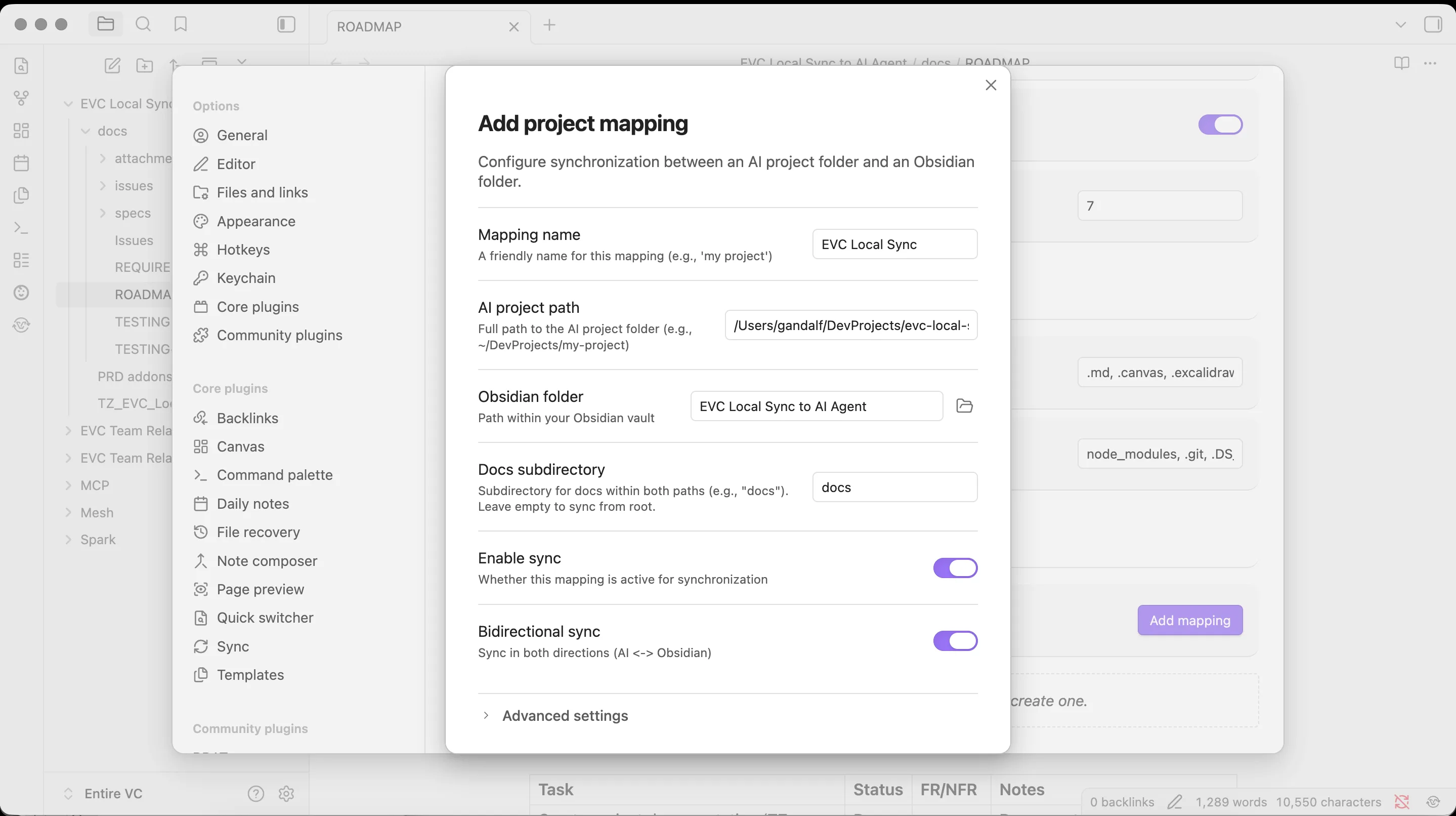
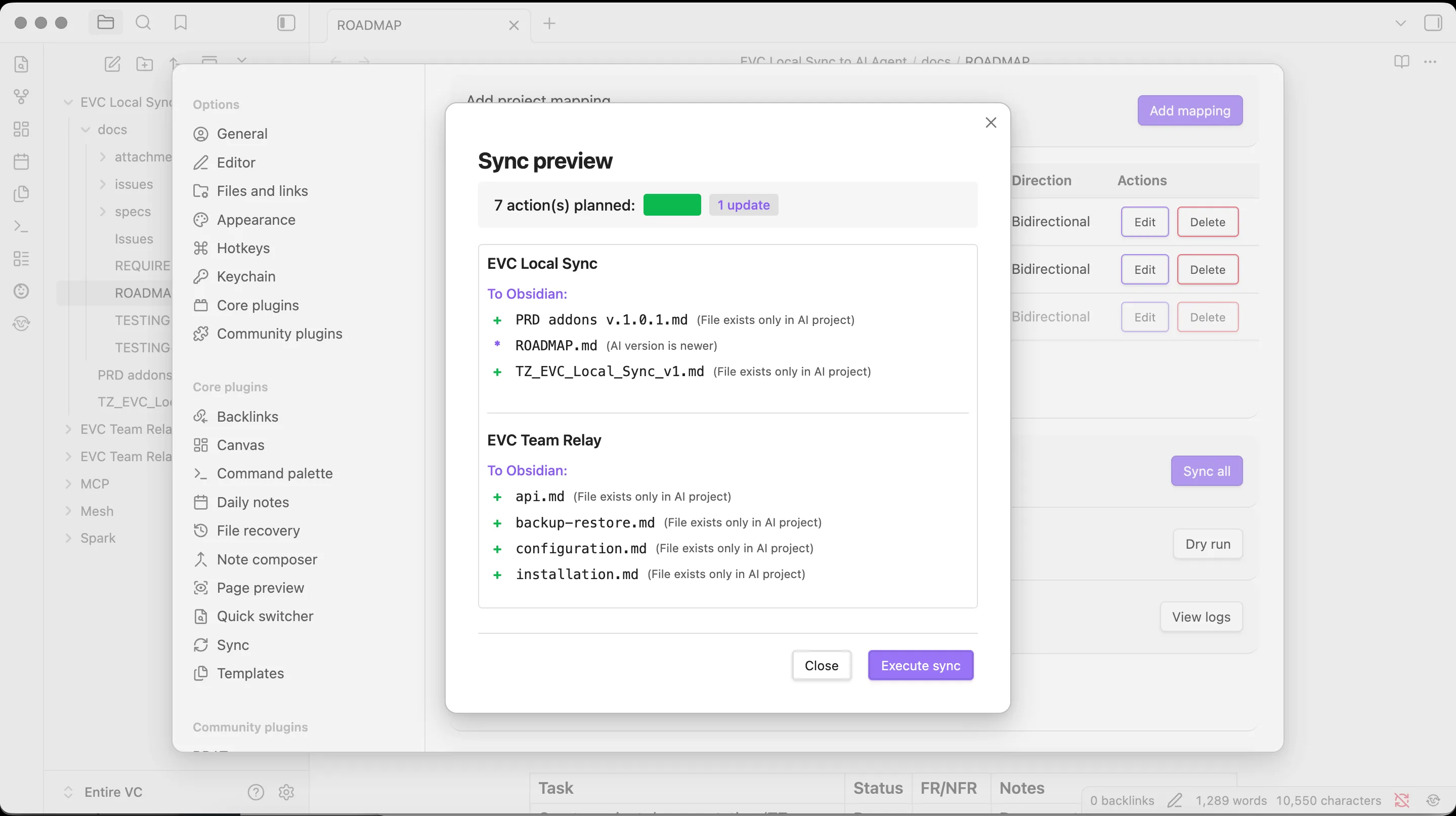
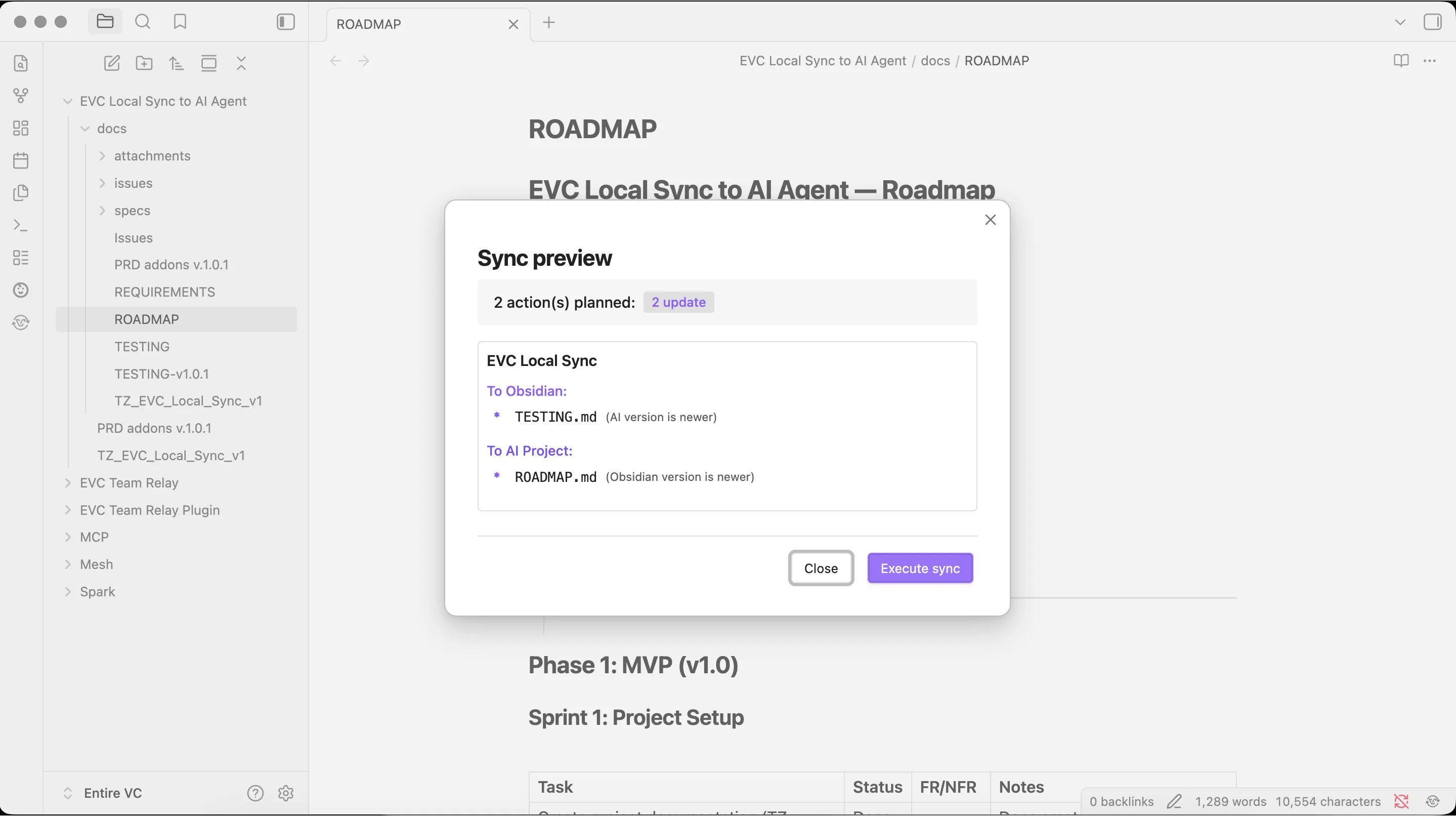
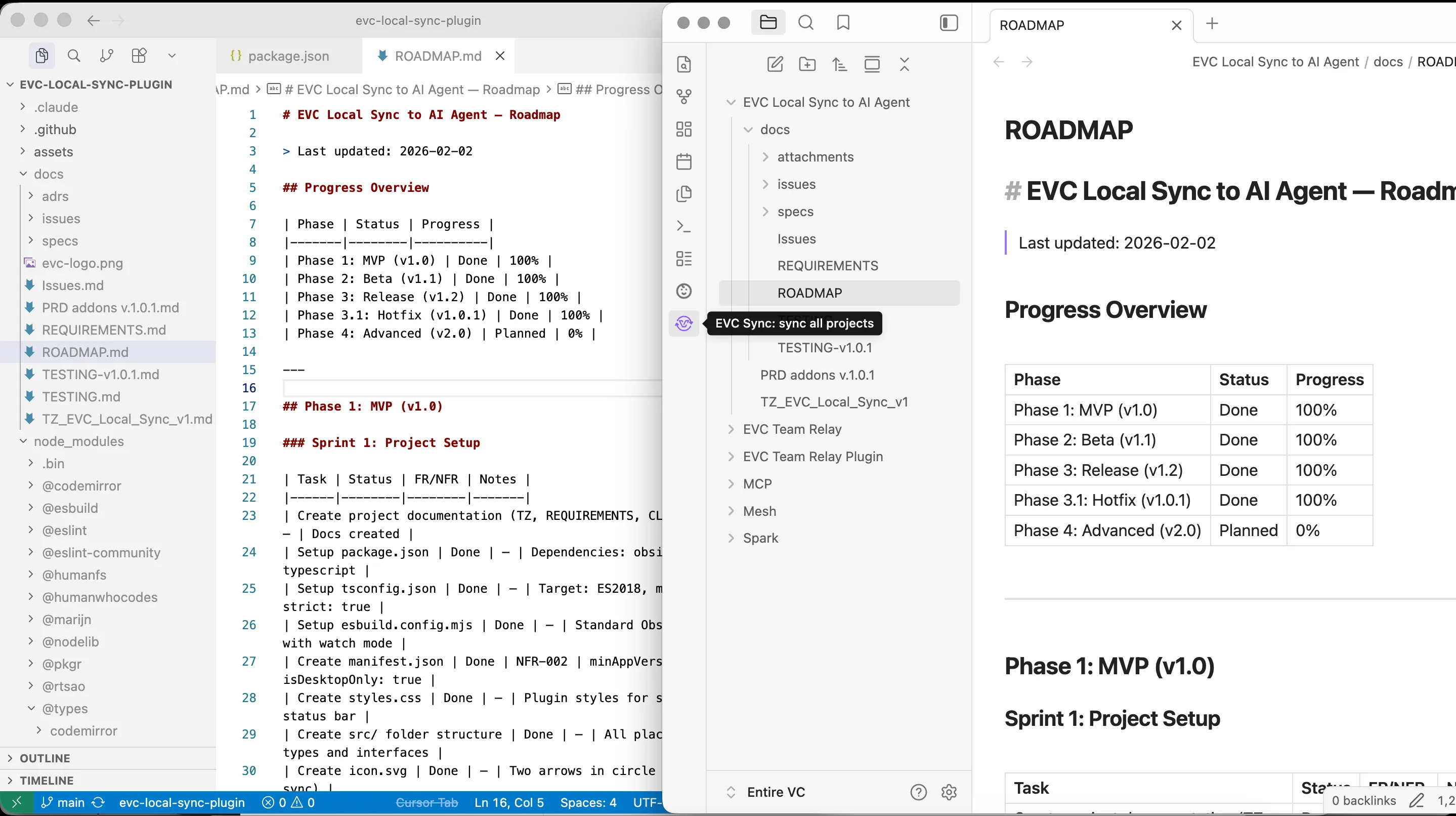
Get your AI workflow running in 5 minutes
Install the plugin, pick your AI tool, get pre-configured rules.
Install
EVC Local Sync is on Obsidian Community Plugins. Open Obsidian → Settings → Community plugins → Browse → search “EVC Local Sync”.
Install in ObsidianOption B — Manual install
View on GitHubPick your AI tool
## Documentation Sync Rules

This project uses EVC Local Sync to keep `/docs` in sync with an Obsidian vault.

### When working with /docs:
- Always read the current state of files in `/docs` before modifying
- After changes to specs or documentation, update the corresponding file in `/docs`
- Use clear commit messages referencing which doc was updated
- Do NOT delete files from `/docs` without explicit confirmation

### File structure:
- `/docs/PRD.md` — Product Requirements (source of truth in Obsidian)
- `/docs/architecture.md` — Technical architecture decisions
- `/docs/changelog.md` — Auto-updated changelog

### Sync behavior:
- Changes in `/docs` are automatically synced to Obsidian vault
- Changes in Obsidian are automatically synced to `/docs`
- Conflicts are resolved by the strategy set in the plugin settings (default: the newer file wins)---
description: Rules for working with /docs synced via EVC Local Sync
globs: docs/**/*.md
---
# Documentation Sync Rules
The `/docs` folder is bidirectionally synced with an Obsidian vault via Local Sync.
## Rules:
- Read `/docs` files before making changes to understand current state
- Update `/docs` when modifying project specs or architecture
- Never delete `/docs` files without explicit user confirmation
- Reference `/docs/PRD.md` as the source of truth for requirements## /docs Sync Rules
This project syncs /docs with Obsidian via EVC Local Sync.
- Read /docs before modifying specs
- Keep /docs updated when changing architecture or requirements
- /docs/PRD.md is the source of truth
- Never delete /docs files without confirmationGet the full Starter Pack
All configs + quickstart guide in one bundle. Free.
Features
Bidirectional sync
Vault to external and back. Changes flow in both directions.
Multiple mappings
Different projects, different folders. Map as many as you need.
Conflict resolution
Newer wins, Obsidian wins, AI wins, or ask every time. You decide.
Dry-run preview
See exactly what changes before syncing. No surprises.
Auto-sync
On change, on startup, on schedule. Set it and forget it.
Backup before overwrite
Files are never lost on conflict. Automatic backup every time.
Scoped by design
Sync only the folders and file types you choose into your project. Access to other vault files depends on your AI tool's permissions.
How it compares
Local Sync vs the alternatives.
| Local Sync | Filesystem MCP | Folder Bridge | Manual copy | Git submodules | |
|---|---|---|---|---|---|
| What the agent sees | Only what you map | Everything under its root | Mapped folder | What you copied | Submodule |
| Bidirectional | ✓ | — | ✓ | ✗ | ✗ |
| Conflict resolution | 4 strategies | Silent overwrite | Basic | — | Merge conflicts |
| Auto-sync | ✓ | ✗ | ✓ | ✗ | ✗ |
| Dry-run preview | ✓ | ✗ | ✗ | — | — |
| AI workflow presets | ✓ | ✗ | ✗ | ✗ | ✗ |
| Backup on overwrite | ✓ | ✗ | ✗ | — | — |
Frequently asked questions
How is EVC Local Sync different from Obsidian Sync?
Obsidian Sync keeps your vault in sync across your own devices — it doesn't touch external folders. Local Sync solves a different problem: keeping files in your Obsidian vault synchronized with a project folder outside the vault, typically a code repository's /docs folder. It is free, MIT-licensed, runs fully locally, and has no subscription.
Does EVC Local Sync work with Claude Code, Cursor, and Windsurf?
Yes. Local Sync ships with pre-configured AI workflow rule files for Claude Code (CLAUDE.md), Cursor (.cursor/rules/docs-sync.mdc), and Windsurf (.windsurfrules). These tell the AI coding tool how to read from and write to the /docs folder that Local Sync keeps in sync with your Obsidian vault.
Is EVC Local Sync free?
Yes, entirely free and open source under the MIT license. There are no paid tiers, no usage limits, and no subscription. Install directly from Obsidian Community Plugins or build from source on GitHub.
What happens if I edit the same file in Obsidian and my code editor at the same time?
Local Sync detects the conflict and applies your configured resolution strategy. There are four, set globally or per mapping: newer file wins (the default), Obsidian wins, AI project wins, or ask every time. A dry-run preview mode shows exactly what will change before anything is overwritten, and a backup-before-overwrite option adds an extra safety net.
Does Local Sync require a server or account?
No. Local Sync requires no external server, no account, and no subscription — all synchronization happens locally on your machine.
Can I sync more than one folder or project at once?
Yes. Local Sync supports multiple independent folder mappings, so different sections of your vault can stay in sync with different projects simultaneously, each with its own conflict-resolution setting.
Built and maintained by Entire VC — open source, MIT-licensed.
Keep your AI docs and Obsidian specs in sync
Free, open source, MIT. Your data never leaves your machine.
Part of AI-native Toolbox
Team Relay
Local Sync pairs with an Obsidian MCP integration — AI agents can read and write vault documents directly. Team Relay adds real-time collaboration and web publishing.
Spark
Discover AI workflows, prompts, and agent skills. The marketplace for AI-native tools.
Community
Questions? Ideas? Join the discussion on Telegram.