

Edit together in Obsidian.
Publish to the web.
Keep your data on your server.
Obsidian is great for personal notes. Collaboration? Not so much.
Obsidian Sync — no real-time collab, $8/user/month.
Notion / Confluence — means leaving Obsidian.
Git sync — merge conflicts on every concurrent edit.
Obsidian Publish — $8/month, limited control.
You want your team in Obsidian, editing together, publishing docs — without giving up control.
Edit the same note. No merge conflicts. Ever.
CRDT (Conflict-free Replicated Data Type) — a data structure that allows edits from multiple sources to merge automatically without conflicts — powered by Yjs. Two people edit the same paragraph and changes merge automatically. No manual resolution, no data loss.
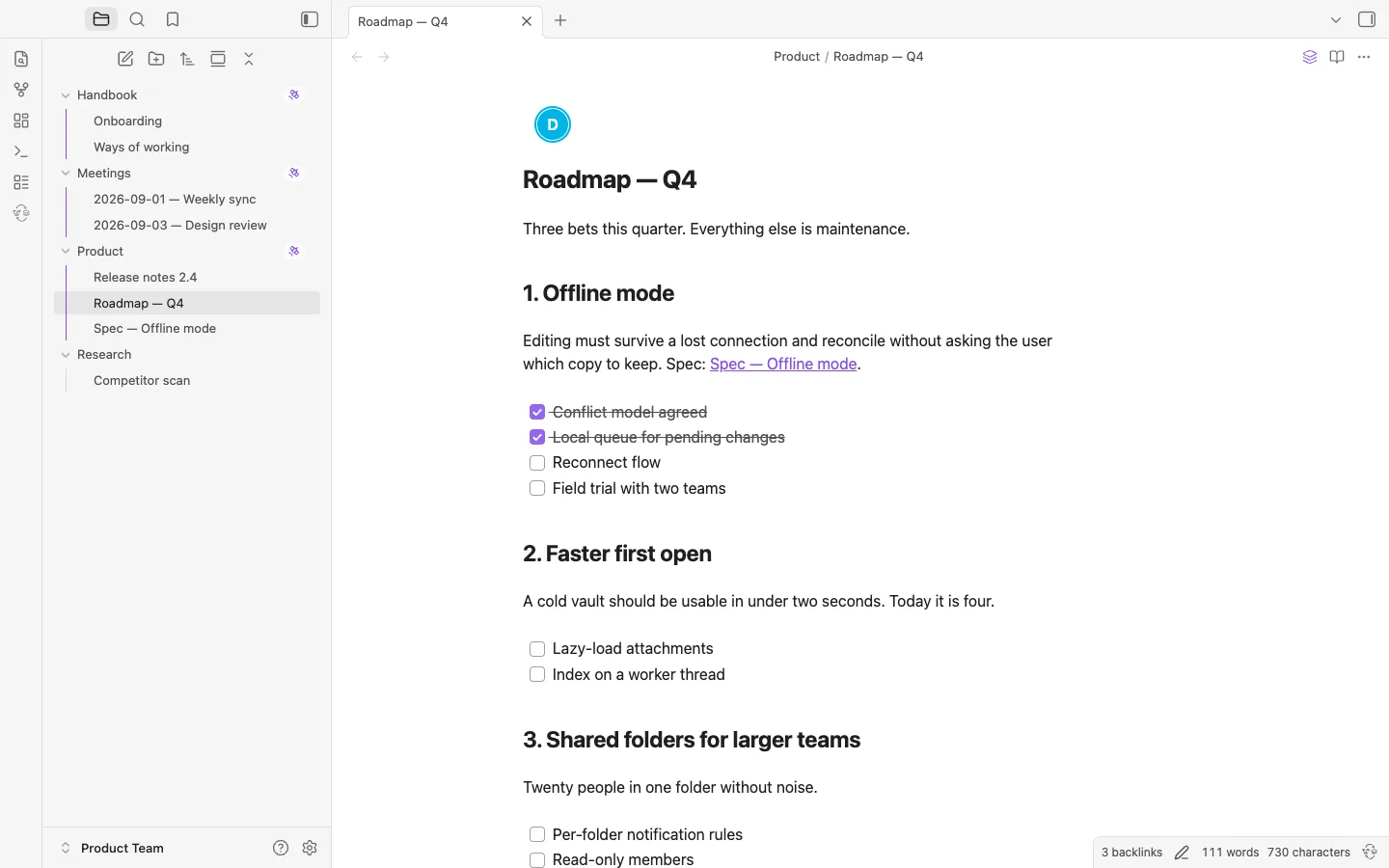
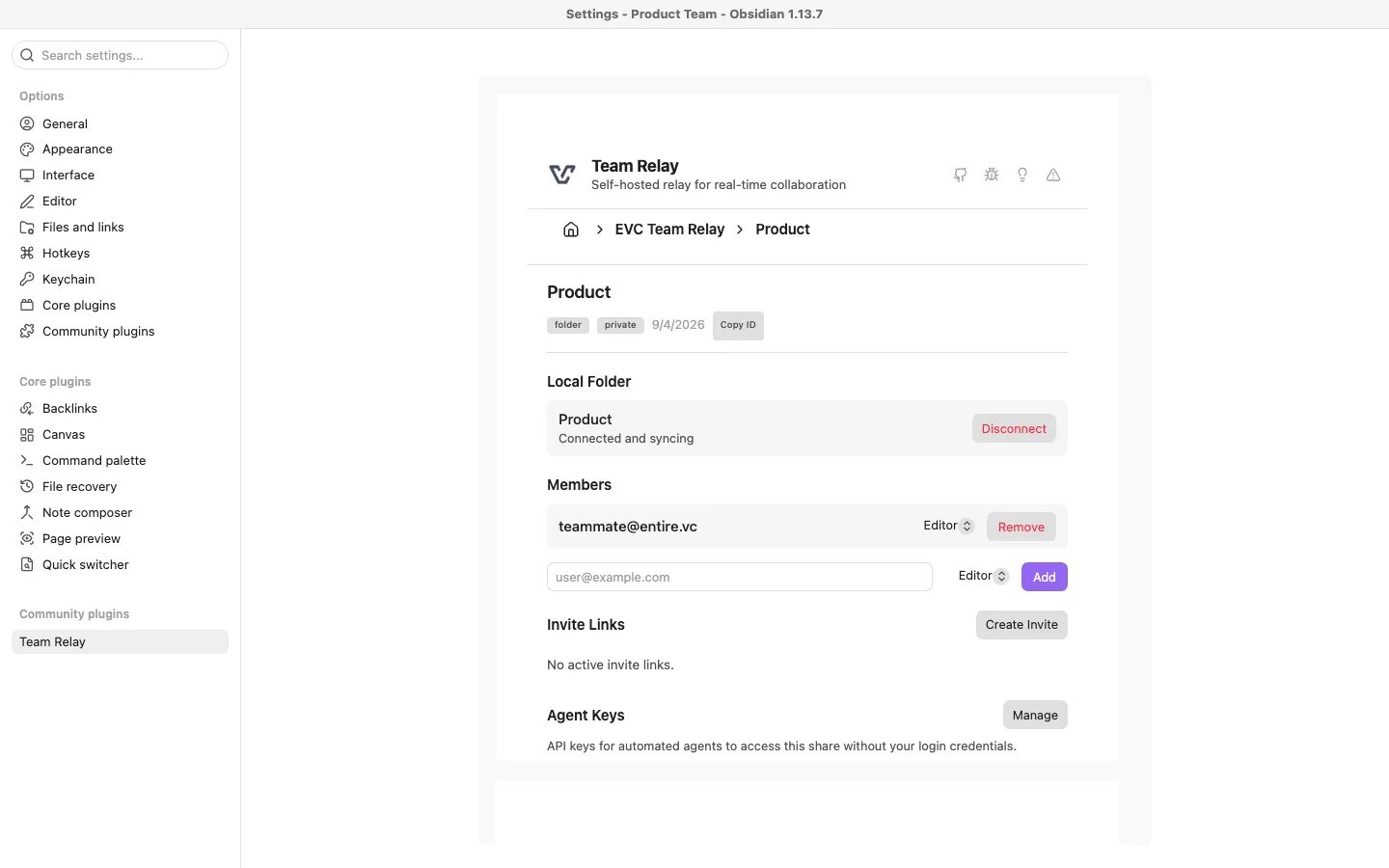
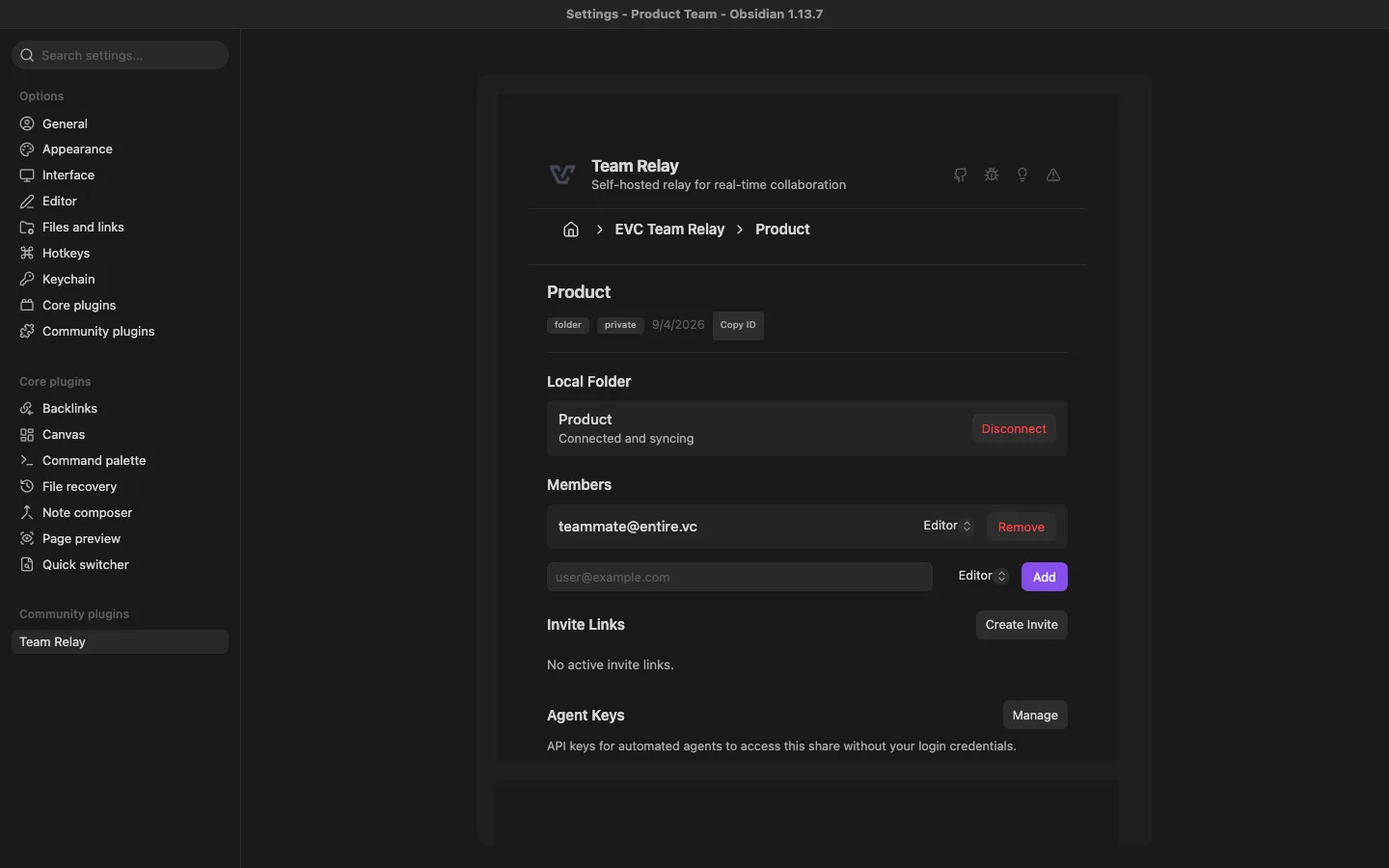
- Share entire folders with viewer or editor permissions
- Offline-first — edit without connection, sync when you're back
- Invite by email — no complicated setup
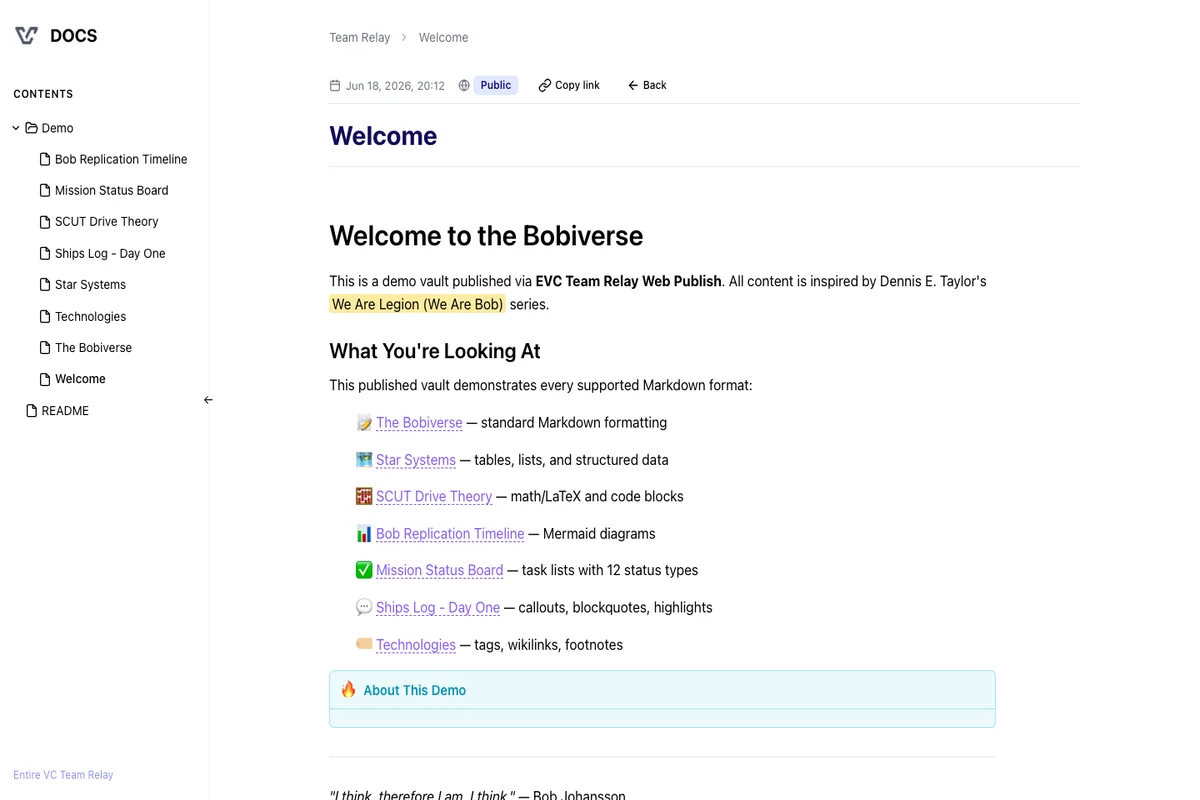
Your notes, live on the web. One click.
Publish a note or an entire folder as a website. Wiki, client portal, docs, blog — whatever you need.
- Public — open to everyone
- Protected — link + token
- Private — login required
- Custom domains
Self-hosted or managed. Your call.
Deploy on your VPS with Docker Compose, or use our hosted version. Same features either way.
- One
docker compose up - OAuth/OIDC, audit logs, webhooks
- User management on your control plane — login, roles, access tokens, no centralized account dependency
- Migrate between hosted and self-hosted anytime
How do AI agents connect to an Obsidian vault via MCP?
Connect your notes to AI agents and coding tools via the obsidian mcp server.
Give AI agents access to your vault
Claude Code, Codex CLI, Cursor, Windsurf — any MCP-compatible tool can read and write your vault directly. No export, no copy-paste. Your agent works with your actual notes. The obsidian claude code integration is configured in one line.
Use notes as context for coding
Feed project specs, architecture docs, and meeting notes to your AI coding assistant. It reads from the vault, stays up to date, writes back when needed.
Automate documentation
CI pipelines, bots, and scripts can create and update docs through the MCP server. API reference generated after deploy? Changelog from git commits? Set it up once.
Native OpenClaw skill
Running autonomous AI agents on OpenClaw? Install the Team Relay skill — your agent gets vault access as a native capability. No MCP process, no stdio transport. One config line.
 MCP Server
 ClawHub
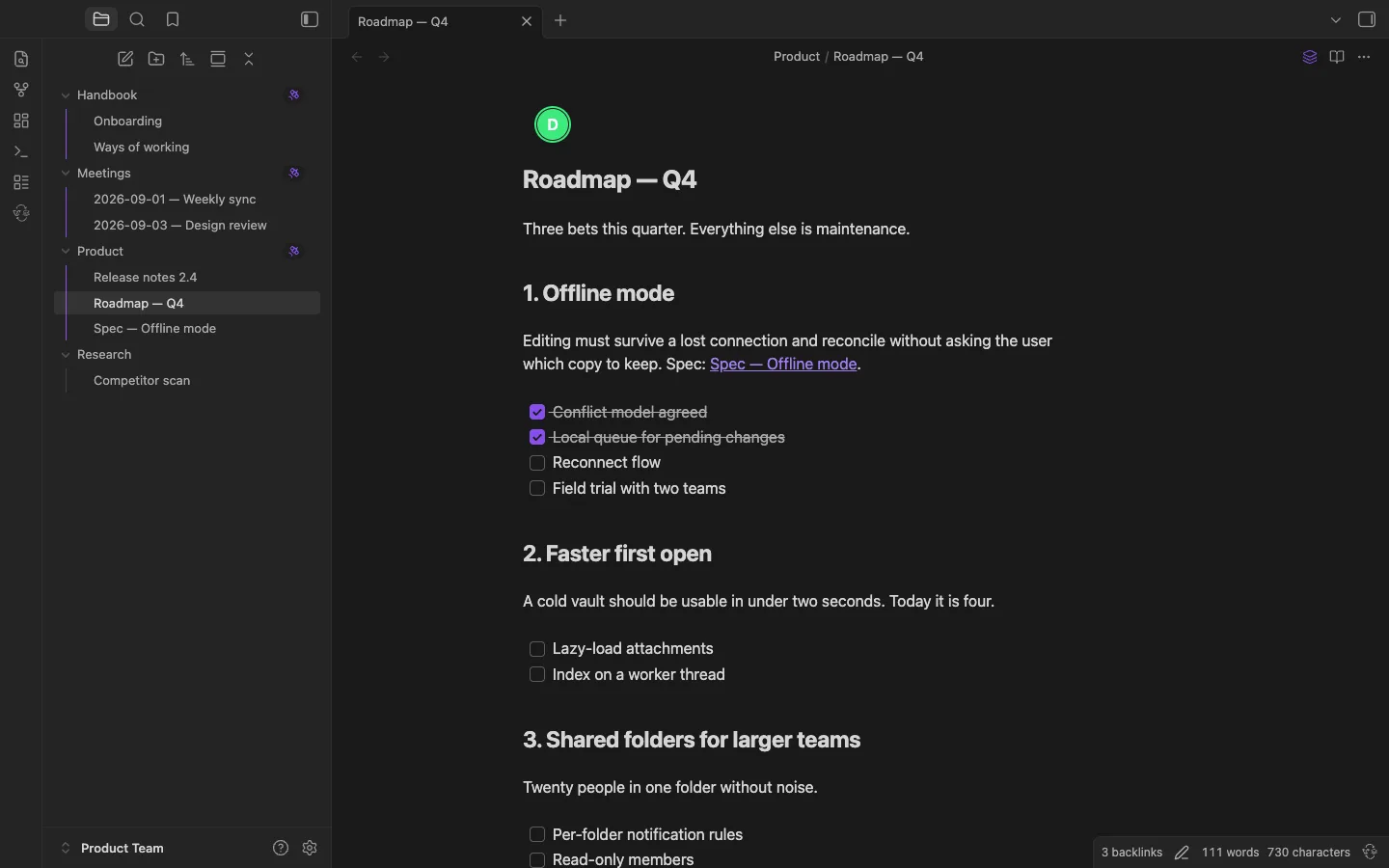
See it in action
How it compares
| Obsidian Sync | Notion | Confluence | Git sync | Team Relay | |
|---|---|---|---|---|---|
| Real-time collab | ✗ | ✓ | ✓ | ✗ | ✓ |
| Works in Obsidian | ✓ | ✗ | ✗ | ✓ | ✓ |
| Web publishing | $8/mo | ✓ | ✓ | manual | ✓ |
| Self-hosted | ✗ | ✗ | $$$ | ✓ | ✓ |
| Offline-first | ✓ | ✗ | ✗ | ✓ | ✓ |
| Data sovereignty | ✗ | ✗ | partial | ✓ | ✓ |
Who uses Team Relay for Obsidian?
Small teams (5–20 people)
Replace Notion or Confluence. Keep Obsidian. Real-time collab without per-seat pricing eating your budget.
Consultants & freelancers
Share deliverables with clients through protected web publishing. No more "can you export that as PDF?"
Dev teams
Documentation that lives in Obsidian, accessible to the whole team. Pair with Local Sync for repo /docs ↔ vault sync.
Content creators
Publish your vault as a website. Custom domains, access control, better than Obsidian Publish at a fraction of the cost.
Pricing
Free to use. No per-seat pricing. No surprises.
Free
Try it out
- Up to 3 shares
- Up to 3 members per share
- 1 publish site (public only)
- 500 MB storage
- 10 MB max file size
- Community support
Builder
Managed hosting for teams. $90/year billed annually.
- Up to 10 shares
- Up to 10 members per share
- 5 publish sites (public + private)
- 3 GB storage
- Community support
Self-hosted
Forever — no limits
- All features, no restrictions
- Unlimited users, sites, storage
- Docker Compose — one command
- Your data never leaves your infra
- Community support (GitHub)
How it works
Install the plugin
Install via BRAT (while the community listing is under review)
- Install the BRAT plugin from Obsidian's community catalogue.
- BRAT settings → Add Beta plugin → paste
https://github.com/entire-vc/evc-team-relay-plugin - Enable Team Relay in Settings → Community plugins. Updates arrive automatically.
Or, once listed: Obsidian Community Plugins.
Connect to a server
Add cp.tr.entire.vc server in plugin settings or enter your self-hosted server URL.
Share and collaborate
Right-click a folder → Share → invite by email. Start editing together.
Frequently asked questions
What is CRDT?
CRDT stands for Conflict-free Replicated Data Type — a data structure that allows edits from multiple sources to merge automatically without conflicts. Team Relay uses the Yjs CRDT library so multiple people can edit the same Obsidian note simultaneously without data loss or manual merge resolution, even when editing offline.
Can I self-host Team Relay for free?
Yes. The Team Relay server is open source (Apache-2.0) and free to self-host with no user limits. Deploy on your own VPS with a single docker compose up command. Your data never leaves your infrastructure.
How does Team Relay compare to Obsidian Sync?
Obsidian Sync keeps your vault in sync across your own devices but does not support real-time collaboration — two people cannot edit the same note simultaneously. Team Relay adds true CRDT-based co-editing, web publishing, and an MCP server for AI agents, with no per-seat pricing when self-hosted.
Does Team Relay work with AI agents like Claude Code?
Yes. Team Relay ships an MCP server that lets any MCP-compatible AI tool — Claude Code, Cursor, Windsurf, Codex CLI — read and write vault documents directly. Your obsidian claude code agent gets native vault access without export or copy-paste.
How do I publish Obsidian notes to the web with Team Relay?
Right-click any folder or note → Share → choose Public, Link-protected, or Login-required visibility. Team Relay generates a URL immediately. Custom domains are supported. The published site updates in real time as you edit in Obsidian.
What about free local-server scripts?
A local Node server is a good experiment. It goes offline the moment you close your laptop, has no user permissions, and edits are destructive — delete something and it's gone with no undo. Team Relay is persistent infrastructure: it runs on a dedicated server, survives machine restarts, enforces roles per folder, and gives you a full CRDT history so nothing is lost.
Built and maintained by Entire VC — open source, Apache-2.0-licensed.